If you’ve jumped into Light No Fire’s massive 2026 content update in the last few months, you’ve probably already stumbled on one of the most common player debates: how much does light no fire planet size actually affect your daily gameplay? It’s not just a random number on your world selection screen, either. The size of the planet you pick to spawn on, build your base, or run quests on will change everything from how long you spend traveling to what rare rewards you can unlock. I’ve put 70+ hours into the 2026 update testing different planet sizes, so I’m breaking down everything you need to know to pick the right one for you.
What Impacts Light No Fire Planet Size in 2026’s Core Update?
Back in the 2025 closed beta, planet size was basically a random roll with no consistent rules, but the 2026 launch update completely overhauled the procedural generation system to tie size to concrete in-game factors. That means you don’t have to roll the dice 20 times to find a planet that fits your needs, as long as you know what to look for when browsing star systems. The devs at Hello Games confirmed this change was made to help players plan their playthroughs better, instead of forcing them to waste time on worlds that don’t fit their goals. You can easily narrow down your search for a light no fire planet size that works for you by checking three core metrics before landing.
There are three core variables that determine every generated planet’s size in the 2026 update:
You can check all three of these factors before you even land on a planet by opening your star map and hovering over the planet icon. Don’t skip this step, especially if you’re looking for a world to build your permanent base on. There’s nothing worse than spending 10 hours setting up a farm, only to realize the planet is way smaller than you wanted and runs out of core resources after a week of play.
How Planet Size Changes Your Exploration Playstyle
The biggest difference between small and large planets is obviously travel time, but that’s just the tip of the iceberg when it comes to how light no fire planet size shapes your experience. For example, the 2026 update added a dynamic fast travel cooldown that scales with planet size: you’ll have to wait 20% longer to fast travel between points on a planet that’s 10x Earth size than you would on a 1x size world. That might not sound like a big deal at first, but it adds up fast if you’re running back and forth between your base and resource veins.
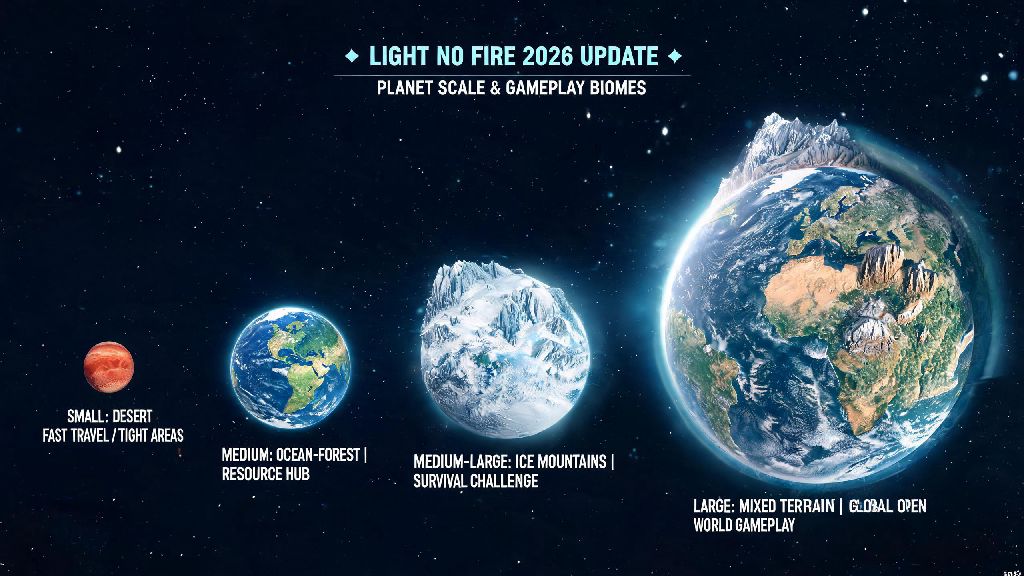
Larger planets also have far more biome diversity, which means you’ll find more unique resources and rare random events. I tested this last month when I spawned on a 12x ice planet in an O-type system: it took me three hours to track down the crystalline ore vein I needed for my upgraded shuttle, but along the way I stumbled on a hidden ancient ruin that gave me a limited-edition glider skin tied to the 2026 anniversary event. I’ve never found that rare of a reward on a planet smaller than 4x Earth size, so that’s a big plus for players who love wandering and finding hidden content.
Smaller planets, on the other hand, are perfect for players who want to focus on questing or PvP. All main quest objectives spawn much closer together on 1x or 2x size planets, so you can knock out an entire story arc in a single play session instead of spending half your time flying between markers. The 2026 PvP update also adds designated open combat zones that cover the entire surface of smaller planets, so you don’t have to spend hours hunting for other players to fight if that’s your thing.
2026 Pro Tips for Choosing the Right Planet Size for Your Run
There’s no one “best” light no fire planet size that works for every player, but there are a few simple rules of thumb you can follow to avoid picking the wrong world for your playstyle. First, figure out what you want to spend most of your time doing in the game before you pick a spawn planet. You can always move to a different world later, but moving your entire base can take hours of playtime, so it’s better to get it right the first time. You don’t have to settle for a light no fire planet size that doesn’t match what you want to do with your playthrough.
Casual players who only log in a few hours a week to run quests and build small bases should stick to 2x to 4x Earth size worlds. You’ll have enough space to explore and find new content, but you won’t waste half your play session traveling between points. Make sure you unlock the basic atmospheric shuttle as early as possible even on smaller worlds, it cuts travel time by 60% compared to using a glider or ground vehicle.
Hardcore base builders and resource collectors should look for 8x to 15x size planets in higher-class star systems. You’ll have access to far more rare resource veins and unique biome types, so you won’t run out of materials for large builds or crafting high-tier items. One important note: the 2026 server engine still has performance limits for large planets with dozens of player-built structures, so if you’re playing on a public multiplayer server, try to coordinate with other players to spread bases out instead of clustering them all in one zone. It’ll cut down on lag for everyone on the server.
PvP players and speedrunners should stick to 0.5x to 1x size worlds. All quest markers and combat zones are packed close together, so you can finish main story runs in under 10 hours or find other players to fight within minutes of spawning. Just keep in mind that smaller planets have fewer base building spots, so don’t plan on building a massive permanent base on a PvP-focused small world.
Common Myths About Light No Fire Planet Size Debunked
With the 2026 update blowing up player counts over the last few months, there’s a lot of bad advice floating around forums and social media about how light no fire planet size works. I tested a lot of these myths to separate fact from fiction, so you don’t have to waste your time trying strategies that don’t work. Most of these myths are leftover from the 2025 beta, when the generation system worked very differently than it does today.
The most common myth I see is that larger planets have higher legendary creature spawn rates. That was true in the 2025 beta, but the 2026 launch update changed spawn rates to tie to biome danger level instead of planet size. You’re just as likely to find a legendary fire wolf on a 1x lava planet as you are on a 15x lava planet, so don’t waste time searching massive worlds just for legendary spawns.
Another common myth is that smaller planets don’t have rare crafting resources. That’s not true either: the spawn rate for rare resources is exactly the same across all planet sizes, the only difference is that larger planets have more total spawn points. If you’re only looking for a small amount of a rare material to craft a specific item, you’ll find it just as fast on a small planet as you would on a large one.
Finally, a lot of new players think planet size is locked for each generated world, but that’s not the case for custom game modes. The 2026 update added a custom server size slider that lets you adjust planet size anywhere from 0.5x to 20x the default size, so you can make worlds as big or as small as you want for private play sessions with friends. You can even adjust the size of already generated worlds in custom mode, as long as you’re the server admin.
At the end of the day, finding the right fit for your playstyle is what makes Light No Fire such a fun game to dive into in 2026. Don’t let the hype around massive open worlds push you into picking a planet size that will only frustrate you after a few hours of play. Whether you’re here for casual questing, hardcore base building, or PvP clashes, light no fire planet size is one setting you’ll want to tweak to get the most out of every session. Try out a few different sizes over your next few play sessions, and you’ll quickly find the sweet spot that makes every minute of play feel worth it.